Explore the world of compost and soil with practical help and advice on composting, humus, and the process of humification. Learn how to make super compost at home, discover the unique benefits of Soilfixer SF60, and understand how these methods can improve soil health and plant growth. Whether you are a gardener, allotment enthusiast, or just curious about better soil management, this guide provides clear answers and useful tips.

Can Biochar Improve Vineyard Soil and Climate Resilience?

When most people think about vineyards, they think about grapes, climate and wine. However, every successful vineyard begins with healthy soil.

Vineyard soil supports root development, stores water, retains nutrients and helps vines cope with environmental stress. This is becoming increasingly important as wine-growing regions experience longer dry periods, higher temperatures, heavier rainfall and growing pressure on valuable topsoil.

Biochar for soil is attracting increasing interest as a way to improve soil structure, retain moisture and support long-term soil health. Although biochar is often discussed as a carbon-storage material, its immediate value to vineyards may lie in its ability to improve water management, reduce soil erosion and create more resilient growing conditions.

Why Vineyard Soil Health Matters

Vineyards are frequently established on sloping land. While slopes can provide favourable sunlight, drainage and growing conditions, they can also leave vineyard soils vulnerable to surface runoff and erosion.

During intense rainfall, water can move quickly across exposed ground, carrying away fine soil particles, organic matter and nutrients. During prolonged dry periods, soils with poor structure or low organic matter may struggle to retain enough moisture to support vines.

The loss of topsoil is not simply a short-term agricultural inconvenience. Topsoil develops slowly and plays a central role in:

  • Water storage
  • Nutrient cycling
  • Root development
  • Soil biological activity
  • Vineyard productivity
  • Resistance to drought and erosion

As soil quality declines, vineyards may become increasingly dependent on irrigation, fertilisers and other external inputs.

Building vineyard resilience therefore means improving the soil’s ability to perform under both extremes: absorbing water during heavy rainfall and retaining moisture during dry conditions.

What Is Biochar and What Does It Do to Soil?

Biochar is a porous, carbon-rich material created by heating biomass in a low-oxygen process known as pyrolysis.

The process converts part of the carbon contained in wood or other plant material into a stable form. When suitable biochar is incorporated into soil, its internal pore structure can influence water storage, nutrient retention, aeration and microbial habitat.

Biochar is not a conventional fertiliser. Instead, it acts as a long-lasting soil amendment that can improve the physical, chemical and biological environment around plant roots.

Potential benefits of adding biochar to soil include:

  • Improved soil water retention
  • Better nutrient retention
  • Reduced nutrient leaching
  • Improved drainage and aeration
  • Greater habitat for beneficial soil microorganisms
  • Improved soil aggregation and structure
  • Reduced soil compaction
  • Long-term storage of stable carbon

The results will depend on the original soil type, existing pH, biochar feedstock, production method, application rate and local growing conditions.
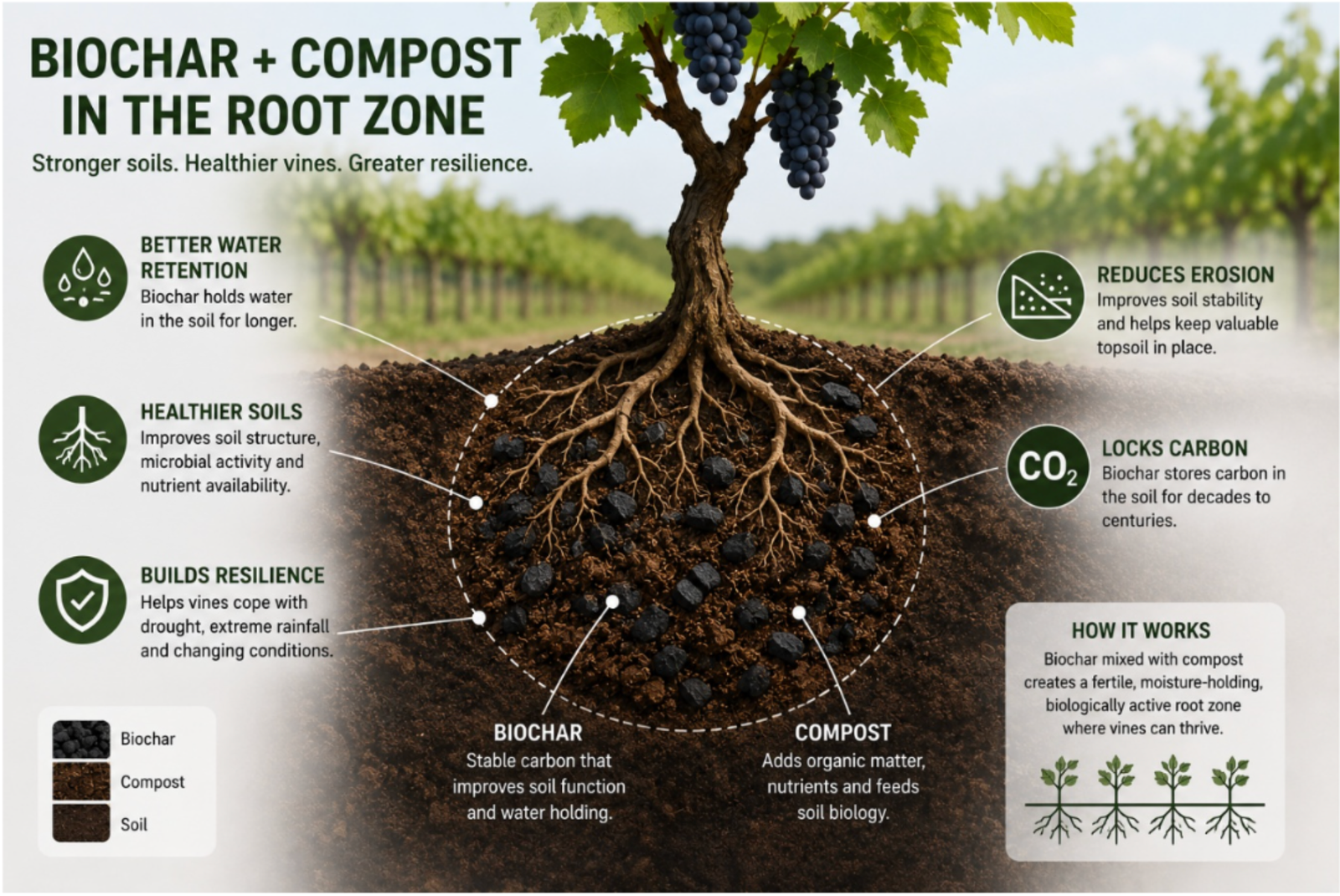
 

Biochar and compost improving water retention, soil health and erosion resistance in a vineyard root zone.

How Can Biochar Improve Vineyard Soil?

Biochar May Help Reduce Vineyard Soil Erosion

One of the most promising potential benefits of biochar for vineyard soil is its ability to reduce soil loss during rainfall.

A study examining Mediterranean vineyard soil found that the erosion rate in biochar-amended soil was approximately three times lower than in untreated soil.

The study reported:

  • A 67% reduction in coarse-fragment erosion
  • A 43% reduction in fine-earth erosion
  • A 34% reduction in splash erosion
  • A 28% improvement in water infiltration
  • A 7% reduction in soil bulk density

The researchers concluded that biochar improved the soil’s sponge function and helped mitigate water erosion.

Read the full research paper: Soil conservation benefits of biochar in Mediterranean vineyards.

For vineyards located on slopes or in areas experiencing intense rainfall, these effects could help protect valuable topsoil and reduce the movement of sediment, organic matter and nutrients away from the site.

Biochar should not replace established erosion-control practices such as cover cropping, mulching, contour management and reduced soil disturbance. However, it may complement these methods as part of a wider vineyard soil-management strategy.

Biochar May Improve Soil Water Retention

Water availability is becoming one of the most significant challenges facing vineyards and other agricultural soils.

In the Mediterranean vineyard study, biochar-amended soil stored an average of 73% more water than untreated soil. During particularly dry periods, the treated soil stored between 171% and 303% more water.

These figures should not be treated as guaranteed results for every vineyard. They were recorded under specific experimental conditions using a particular soil, biochar and application method.

Nevertheless, the findings demonstrate the potential for biochar to improve water retention in soil.

Biochar contains an extensive network of pores. When it is correctly incorporated and conditioned, these pores can hold moisture and help slow the rate at which soil dries after rainfall or irrigation.

This may be particularly useful in:

  • Sandy or free-draining soils
  • Vineyards exposed to prolonged dry weather
  • Areas with restricted irrigation
  • Sloping land affected by rapid runoff
  • Degraded soils with low organic matter
  • Newly planted vineyard rows

Biochar cannot eliminate the need for irrigation in every vineyard. It may, however, help soil make more efficient use of available rainfall and irrigation water.

Biochar Can Support Long-Term Soil Improvement

Biochar remains in soil for much longer than ordinary compost or fresh organic matter.

A long-term study in a Tuscan vineyard found that measurable changes remained present ten years after biochar application. The biochar-amended soil had higher organic matter, nutrient content and water availability, together with lower soil bulk density.

The researchers also observed changes in vine-root development that suggested water and nutrients were more readily available within the amended soil.

Read the open-access research: The long-term effect of biochar application to Vitis vinifera.

These findings are important for vineyards because grapevines are perennial crops. The value of a soil amendment should not be judged solely by what happens during the first growing season.

The more important question may be whether the amendment helps protect soil condition and vineyard productivity over many years.

Biochar May Improve Nutrient Retention

Biochar’s porous structure and surface chemistry can help retain certain nutrients within the soil.

This may reduce the speed at which nutrients are lost through runoff or leaching and help keep them within the vine’s root zone. The pore structure can also provide habitat for beneficial bacteria, fungi and other soil organisms involved in nutrient cycling.

However, untreated biochar may initially absorb nutrients from the surrounding soil before its pores become conditioned.

For this reason, biochar is often activated by:

  • Mixing it with mature compost
  • Adding it during the composting process
  • Soaking it in a nutrient-rich solution
  • Blending it with manure or other organic material

You can learn more in SoilFixer’s guide to activated biochar for soil health.

For growers seeking a ready-to-use product, activated biochar compost may be more appropriate than applying untreated biochar directly around established plants.

Biochar or Biochar Compost: Which Is Best for Soil?

Biochar and biochar compost serve related but slightly different purposes.

Biochar Granules

Pure biochar granules provide stable carbon and long-lasting pore structure. They may be suitable for incorporation during vineyard establishment, soil renovation, agricultural projects or larger soil-improvement programmes.

Raw biochar should normally be activated or blended with compost or another nutrient source before it is added to planted soil.

SoilFixer’s biochar granules for soil improvement are produced in the UK and are available in different quantities.

For large vineyard, agricultural or landscaping requirements, SoilFixer can also discuss bulk biochar orders.

SF60 Biochar Soil Improver

SF60 Biochar Super Compost is a ready-to-use soil improver containing activated biochar, composted manure and fine wood compost.

It is designed to improve:

  • Soil structure
  • Water retention
  • Nutrient availability
  • Root-zone biology
  • Beneficial fungal activity
  • Tired or depleted soil

Because the biochar is already blended with nutrient-rich organic material, SF60 can begin supporting the soil without the same conditioning period required by untreated biochar.

SF40 Biochar Compost

SF40 Biochar Multi-Purpose Compost is a peat-free blend containing biochar and sustainable compost.

It is intended for applications including:

  • Containers
  • Raised beds
  • Planting areas
  • Potting
  • General soil improvement
  • Topsoil enhancement

For small-scale growing, vineyard nurseries, propagation or planting projects, a ready-to-use biochar compost may provide a practical introduction to the benefits of biochar.

Does Biochar Increase Grape Yield?

Biochar does not automatically produce more grapes, and it cannot guarantee better wine.

A four-year field experiment in Tuscany reported higher grape yields in biochar-treated plots during each harvest year included in the study. The increase compared with untreated plots ranged from approximately 16% to 66%, with the greatest differences recorded during lower-rainfall years.

The researchers did not identify significant detrimental effects on the main grape-quality indicators assessed.

Read the research paper: Biochar increases vineyard productivity without affecting grape quality.

However, other studies have produced more limited results.

Research at two Oregon vineyards found that biochar increased soil water content and the availability of carbon, nitrogen and several nutrients. However, the researchers did not observe an immediate increase in vine productivity during the initial study period.

A study involving a low-organic-carbon vineyard soil in Switzerland also found that biochar and biochar-compost did not automatically produce significant improvements in vine growth or grape quality under the conditions examined.

View the research record: Biochar and biochar-compost as vineyard soil amendments.

These mixed findings demonstrate that biochar performance depends on the interaction between:

  • Soil type
  • Soil pH
  • Existing organic matter
  • Climate
  • Vine variety
  • Water availability
  • Biochar quality
  • Application rate
  • Incorporation method

The primary purpose of biochar does not always need to be increasing yield. In many vineyards, its greater value may be protecting soil condition, improving water management and maintaining existing productivity during increasingly unpredictable growing conditions.

Is Biochar Suitable for Every Type of Soil?

Biochar is not a universal solution and should not be applied without first understanding the existing soil.

Before using biochar in vineyard or agricultural soil, growers should assess:

  • Soil texture
  • Soil structure
  • Organic-matter content
  • Existing pH
  • Nutrient availability
  • Drainage
  • Compaction
  • Erosion risk
  • Irrigation availability
  • Rooting depth
  • The objective of the application

Biochar can raise soil pH. This may benefit acidic soil but could be undesirable in soil that is already alkaline.

Its effect on water retention may also differ between soil types. Sandy and free-draining soils may respond differently from clay-rich soils.

The Royal Horticultural Society notes that reported effects of biochar include improved water and nutrient retention, particularly in sandy soil, together with improved drainage, aeration and habitat for beneficial soil microbes. It also advises considering the pH of the biochar and the receiving soil.

Read the RHS guidance on biochar and soil.

A soil analysis and a clearly defined objective should therefore come before large-scale application.

For commercial vineyards, farms and land-restoration projects, a controlled trial is often the most responsible starting point. Treated and untreated areas can then be compared for:

  • Soil moisture
  • Water infiltration
  • Soil structure
  • Vine response
  • Nutrient availability
  • Yield
  • Fruit-quality indicators

Application rates used in published studies should not automatically be copied because the appropriate rate will depend on the soil, product and intended outcome.

Biochar for Sustainable Vineyard Management

Biochar cannot solve every challenge facing modern viticulture.

It should be considered alongside good vineyard-management practices such as:

  • Cover cropping
  • Compost application
  • Reduced soil disturbance
  • Mulching
  • Erosion control
  • Organic-matter management
  • Carefully planned irrigation
  • Regular soil testing

When appropriately selected and applied, biochar may contribute to:

  • Healthier vineyard soil
  • Reduced soil erosion
  • Lower surface runoff
  • Improved water infiltration
  • Greater soil water retention
  • Better nutrient retention
  • Improved soil structure
  • Increased soil biological activity
  • Long-term carbon storage
  • Greater resilience to drought and heavy rainfall

Where Can You Buy Biochar for Soil in the UK?

SoilFixer produces UK-made biochar and biochar-compost products for gardens, growing projects, landscaping, agriculture and wider soil-improvement applications.

Depending on the project, suitable options may include:

For vineyards, farms, estates, landscaping projects or larger commercial requirements, contact SoilFixer for bulk biochar and biochar-compost enquiries.

Can Biochar Help Vineyards Become More Resilient?

Current research suggests that biochar can support more resilient vineyard soil, particularly where land is vulnerable to erosion, low organic matter, rapid drainage or water stress.

It should not be viewed simply as a way to produce more grapes. Its strategic value may lie in helping vineyards protect their soil, retain more water and maintain productivity during increasingly unpredictable conditions.

The wine industry has always been shaped by its relationship with the land. As environmental pressures increase, practices that protect soil health and support long-term resilience will become increasingly valuable.

At SoilFixer, we believe high-quality biochar and biochar compost can form part of that solution.

Ready to improve your soil? Explore SoilFixer’s UK biochar and biochar-compost products or contact our team about a commercial or bulk order.

Frequently Asked Questions

What does biochar do to soil?

Biochar can improve water and nutrient retention, soil structure, aeration and microbial habitat. Its effects depend on the biochar properties and the existing soil.

Is biochar good for vineyard soil?

Biochar may benefit vineyard soil by reducing erosion, increasing water storage and supporting long-term soil health. Soil analysis and small-scale trials are recommended before wider application.

Is biochar good for sandy soil?

Biochar may be particularly useful in sandy or free-draining soil because its pore structure can help retain water and nutrients that might otherwise drain away quickly.

Is biochar good for clay soil?

Biochar may help improve aggregation, aeration and structure in some clay soils. Results depend on the biochar particle size, application rate and existing soil condition.

Should biochar be mixed with compost?

Mixing or composting biochar with nutrient-rich organic matter can activate it before application. This introduces moisture, nutrients and biological activity into the biochar’s pore structure.

What is biochar compost?

Biochar compost is a blend of biochar and compost. It combines the nutrients and organic matter supplied by compost with the persistent pore structure and carbon supplied by biochar.

How do you apply biochar to soil?

Biochar can be mixed with compost, activated with a nutrient solution and incorporated into the root zone. The correct application method and rate will depend on the soil and planting situation.

Where can I buy biochar in the UK?

SoilFixer supplies UK-made biochar granules, biochar soil improver and peat-free biochar compost through its online shop. Bulk quantities are available by contacting SoilFixer directly.
Why Biochar Compost is Essential for Healthier Soil This Autumn

As the growing season draws to a close, soils are often left depleted just as winter approaches. Autumn is the most effective time to rebuild and protect soil health, ensuring strong performance in the seasons ahead. Using the best compost for autumn soil improvement, such as SoilFixer Biochar Composts, allows you to restore nutrients, enhance soil structure, and support long-term biological activity — creating the conditions for a healthier, more resilient garden come spring.

Why Use the Best Compost for Autumn Soil Improvement?

Biochar Compost Ingredients: What’s in SF40 and SF60?

Our SF60 starts life as SF40, before we enrich it with the ideal amount of composted horse manure.

  • SF40 contains 20% biochar, 70% locally and sustainably sourced composted brash, and 10% composted horse manure. This is our growing media compost — perfect for pots, beds, and general use.
  • SF60 (our soil improver) contains 20% biochar, 20% locally and sustainably sourced composted brash, and 60% composted horse manure.

Why Apply Biochar Compost in Autumn?

Autumn warmth and moisture (with soils above 8°C) make this a prime time to apply the best compost for autumn soil improvement. Biochar compost supports microbial life through the winter and provides an early boost as temperatures rise again in spring.

Over winter, compost and biochar integrate further as microbes enter and colonise the biochar’s pores — ‘inoculating’ it. This enhances its role as the best compost for autumn soil improvement, helping to retain nutrients for spring planting while reducing leaching during heavy autumn rain.

Should I Use SF40 or SF60 Over Winter?

For vegetable and flower growers, we recommend SF60. It delivers a much-needed boost of microbes, providing essential biological benefits to your plants as they move into spring.

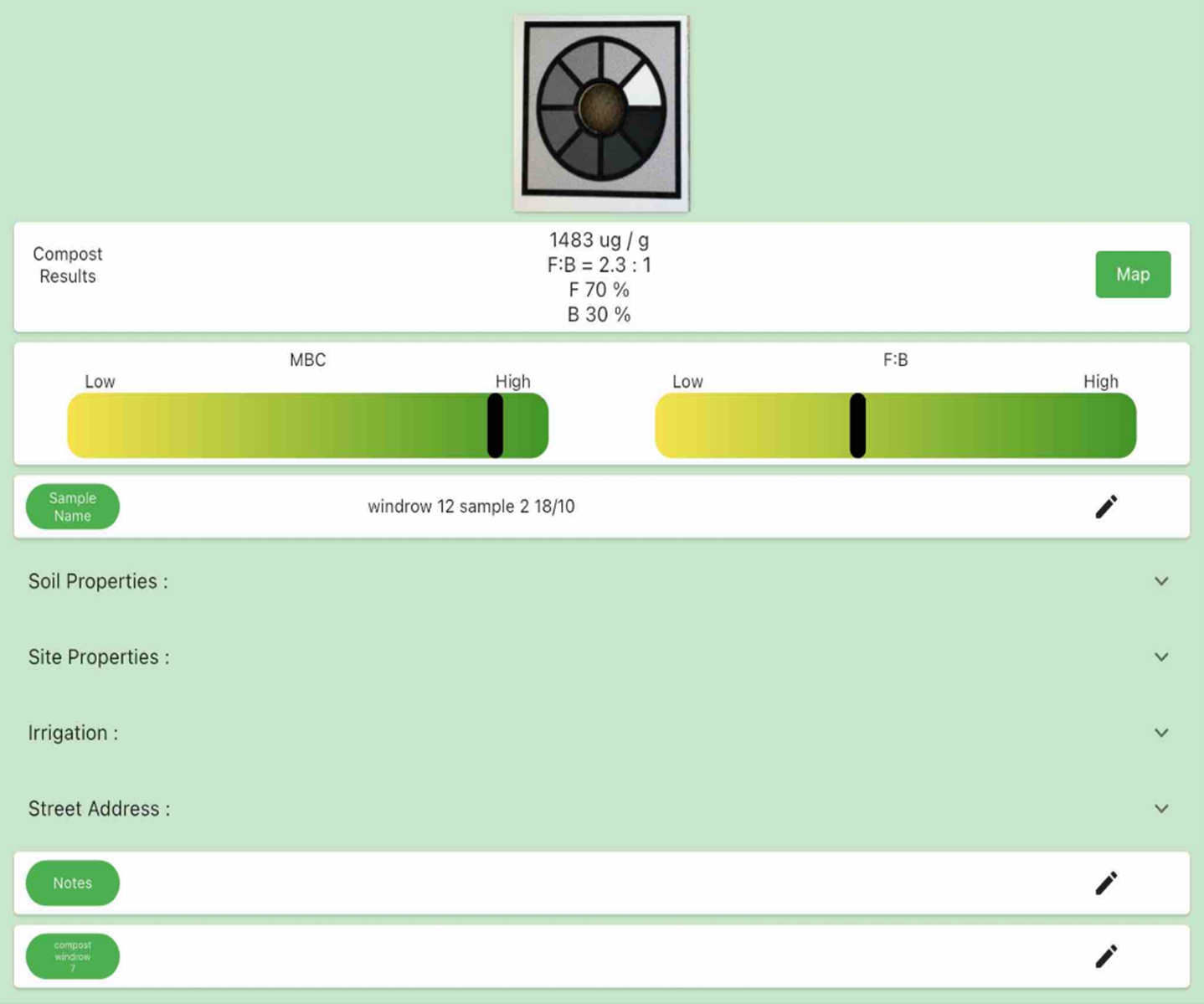
Before we make SF60 by adding the horse manure, it all begins as SF40 — and our microbiome readings are exceptional, boasting over 1400 µg/g. In other words, it’s highly active, biologically rich compost!

If you’re looking to boost lawns, trees, or shrubs, our SF40 multi-purpose compost provides a healthy foundation to support growth throughout the winter.

Great Long-Term Effects

Healthy soil doesn’t happen by accident — it’s built through regular care and attention. Autumn is the perfect time to start. By applying biochar compost now, you’re feeding your soil, supporting microbial life, and locking away carbon for the future.

What Are Compost Activators and Do They Really Work?

Compost activators are designed to speed up decomposition, but their effectiveness depends on factors like temperature, materials, and composting methods.

In gardening, the term compost activator is used to cover many products with names such as compost maker, accelerator, inoculator, catalyst, and humification agent also being used.  In this article, we define the terms more precisely and use these to look at what they contain (the ingredients) and how well they work. The blog was updated in December 2022.

To activate means to start, to get a reaction going. A compost activator should therefore help get things started. There are several types of activators and we go through each below.

To accelerate means to increase the speed (rate), so they should increase the speed of composting (ie reduce the time it takes to make good quality compost. We can define a compost accelerator as a product that increases the speed (rate) of decomposition.

We do not believe commercial compost accelerators accelerate the rate of garden composting to any meaningful degree.  (We explain why and the detail below). The only meaningful way to accelerate (increase the rate) of decomposition is to increase the heap temperature.

What are compost inoculators?

Inoculation is now mainly used when talking about vaccines, but it comes from the term to add an effective agent into a medium. We define a compost inoculator as a substance that adds microbes (bacteria/fungi) or microbial-enzyme-based substances to the waste to ‘kick start’ (inoculate) the composting mix.

Based on our composting work, except in extremely rare situations, paying for inoculators is not required.  We know most food and green waste decompose even when left on a flat surface  – because bacterial spores are everywhere.

If you really want to ‘kick start’ the compost heap/bin, the best method is to add a handful of compost or soil into the new waste – as these both contain billions of bacteria that will inoculate for free.

What is a Biochar compost additive?

Biochar can be mixed with finished compost as a means of activating the biochar. Biochar can also be added to the compost mix to co-compost biochar and waste. This creates activated compost-biochar such as SF40 and SF60.

What is a Compost Humification Agent?

This is a new term introduced by SoilFixer. During composting, compounds known as humus (or colloidal humus) are formed. These compounds are the real active items in compost.

Typically compost contains less than 1-5% of these valuable compounds. A humification agent increases the amount of colloidal humus in your final compost typically to 15-30%.

Avid readers of our blog will note that the compost Humification is 80% biochar combined with trace minerals.

What is the best Compost Activator?

It all depends on what you are trying to achieve or the problem you are trying to solve.

Some common trade names would include: Westland ‘Make your own compost’ (powder), J Arthur’s Garotta (powder), Vitax Compost Maker (powder), Envil, Seaweed and Seaweed extracts (liquids and powder), Bio-tal (liquid), Neudorff (powder), Sachets of enzymes, microbes or herbs (e.g. QR), our own SoilFixer Compost Humification Agent (powder/granule).

(SoilFixer recognizes the above names and trademarks. Use of a trademark name does not imply any association with, or endorsement by, the trademark owner of any SoilFixer product. The views expressed on these products are those solely of the author).

Do I need to use/add Compost Activators?

It all depends on what you are trying to achieve or the problem you are trying to solve. However, in almost all cases, we can advise the purchase of activators is not needed as there are alternatives readily available in your garden.

The one exception is when you are trying to create a biochar super compost – which requires the addition of a biochar and or compost humification agent (e.g. SoilFixer’s CHA).

Will Compost Activators help my compost breakdown more quickly?

Technically yes… but practically, the answer is a huge NO because the temperature (heat) has massively more impact. Let us assume as an example that the activator gives a 10% increase in performance:


Compost at 10CHot compost at 60C
Days to complete compost540 days

(18 months)

16 days
Increase in rate from “activator” 10%-54 days-1.6 days
Days with activator486days14.4 day

Unless you are a commercial composter, it is unlikely you going not going to notice the 10% reduction in days. However, the difference between the time at 10C and 60C is huge – 14 vs 486!

For every 10C increase in bin temperature, the speed doubles, ie takes half the time to decompose. Heat will reduce the time by a factor of X8, X16, or x32 times faster.

We are often asked why is my compost not breaking down?  It has been 18 months and I still don’t have any compost – how do I get my compost faster?

Garden composters often read articles on how Activators A or B will speed up composting.  If you are looking for any compost activator to speed up composting in a meaningful or noticeable way, I’m afraid you are going to be disappointed in your purchase.

It really does not matter which one you opt for: none can change the fundamental laws of nature dictating how fast microbial reactions take place (see Q10, Arrhenius equation).

This does not mean activators do not work, nor that it is impossible to get fast compost – it just means there are some facts to know about what works and why.

First, let’s look at the rate (speed) at which composting takes place:

What will make my compost break down faster?

The following all can impact the rate of microbial reaction: type of bacteria (meso, thermophilic etc), surface area (large bits or shredded bits), nature of the waste (is it easy to digest (e.g. grass, cooked food, proteins, and carbohydrates like cellulose) or hard (e.g. wood, lignin).

There are then a number of what we call limiting factors that can limit or totally prevent decomposition. For example: if you have no nitrogen (or not enough) the reaction cannot proceed. If you have no micronutrients in your waste, some of the bacterial enzymes cannot be made/proceed. If you have no oxygen or water aerobic composting cannot proceed or can be limited.

You will find many websites advising adding nitrogen as ‘the‘ solution to increasing the rate of decomposition.  Indeed almost all the compost activators are “ground up nitrogen”. But and we stress again, nitrogen does not increase the rate of decomposition – it merely ensures it can happen. Once it can happen, the rate at which it happens is determined by the temperature (i.e. Arrhenius Q10 equation)

The Q10 law of natural science (named after Arrhenius) states: for every 10ºC increase in (composting) temperature, the speed of reaction (rate of decay) doubles. Hot composting at 60ºC is x32 times faster than cold composting at ambient 10C. Hot composting can (and does) deliver compost in 30 days, cold composting delivers compost in 12-18 months).

You can use this ‘rough rule thumb’: take the length of time your composting takes at ambient temperature in months (e.g. 36, 18, 12, six months) and convert to days (so 36, 18, 12, six days) for how long it will take for hot composting.  If your current compost takes 18 months (cold system) it will take approx 18 days at 60C (hot).

The only other activity on the list that gets close to helping increase the speed of composting is increasing the surface area of the waste to be composted. To reduce the particle size – i.e. shred, shred, and more shredding.

Tip: keep your compost warm! If heat (temperature) is the secret to fast composting, what benefit do all the composting activators on sale really have?

What are compost activators made from –  part 1, nitrogen-based activators

After a lot of searching of labels and material safety data sheets, it became clear the major ingredient in almost all commercial activators is easily digestible nitrogen.

Many (indeed most) of the compost activators on sale are ground-up substances that contain a fair amount of nitrogen. These will usually be made from cheap resources such as chicken poo, blood and bone meal, fish waste.

But here is the catch – unless your waste has no nitrogen (or not enough) then adding more will not change things.  Most compost waste simply does not need extra nitrogen.

From personal testing, I became dubious about the benefit of adding accelerators. I looked at the science and ingredients a bit further. They all state ‘concentrated, readily available.  Ok… but if we’re generous and say they are 100% concentrated nitrogen, then if you added 10g (typical scoop as recommended); that is 10g of ‘nitrogen’ bacterial food.

Now look at the waste you’re adding: typically you add 5-10 Kg of waste in a caddy/bucket and 25-50 Kg in a wheelbarrow. This will have around 5% nitrogen on a weight basis, so each addition of green waste/food waste adds 250g of nitrogen. In other words, you add x25 the quantity of nitrogen than that added from the activator packet.

Is the nitrogen in the compost waste readily available? It really depends – in any soft food (kitchen waste) it is just as easy for bacteria to access (eat) as in the activators. Items like grass are high in nitrogen (c10%) and are readily decomposed – days at 60C.

If you’re an advocate of one of the activator brands (i.e. they work for you), then maybe have a look at the contents label and just check you are happy this is a cost-effective way of adding the contents.

Natural-nitrogen activators

There are plenty of naturally occurring nitrogen “compost activators” such as:

  • Soft greens (comfrey, nettles, grass clippings, alfalfa, clover)
  • Manures (cow, pig, chicken, horse etc)
  • Urine (pee – from various sources!)

All these materials are ‘soft’ and ‘easy’ for microbes (bacteria) to digest. They have high nitrogen-to-carbon ratio (towards 10:1) and are hence good C/N balancers where you have a lot of carbon-rich materials like straw, woody stalks or wood.

If you do not have access to soft items like grass clippings, our advice would be to seek out the lowest cost “nitrogen”. Rather than opt for a branded compost activator,  seek out the cheapest form of organic nitrogen fertilizer.

For example, a 10Kg tub of chicken pellets (or blood meal) is about half the price Kg/Kg than a small pack of “compost accelerators” ie,  £1.50/kg versus £3.00/kg.

You will often see urine (pee) listed as a compost activator. We are highly dubious of the real value of adding pee to compost. Urine has a tiny amount of urea, which in turn has tiny amounts of nitrogen.

If you are hot composting – the addition of +99% water (which takes heat to remove it as steam) is negative. In a cold composting system, if the heap is very dry urine is OK.

If the heap is damp, it compounds aeration issues. Our expertise says those seeing really positive impact probably have compost bins that were too dry and the water is improving the process.

Tip: If your waste is general food and garden items and not particularly woody first ensure it is well shredded, second insulate your compost bin to keep the bin contents hot. These are much more likely causes for slow composting than lack of nitrogen.

What are Compost Humification Agents

This is a new term introduced by SoilFixer. During composting, compounds known as humus (or colloidal humus) are formed. These compounds are the real active items in compost (read here).

Typically compost contains less than 1-5% of these valuable compounds. A humification agent increases the amount of colloidal humus in your final compost typically to 15-30%.

The SoilFixer humification agent is a mixture of biochar, micronized oxides (tiny bits of trace minerals), and composting microbes (from SF60/compost).

  • Trace minerals (e.g. calcium, iron) are key to humification
  • Composting microbes are needed – adding a small amount helps guarantee a rapid start
  • Biochar is known to act as a catalyst/activator in the composting process.

The science behind how and why biochar works is constantly developing (e.g. new information on DIET (direct interspecies electron transfer) is speeding the process by 0-30%).

Using the above definitions of ‘activator’ and ‘inoculator’, the SoilFixer Compost Humification Agent (CHA) is both an activator and inoculator.

We are not aware of any other compost additive that acts to increase humification.  It also helps to reduce compost odours, lower nitrous oxide and methane (potent climate change gases).

Biochar – the double win

Used correctly biochar can have a tremendous positive impact on soil health and plant growth. In recent years, adding biochar to compost has become the recommended way to “activate” biochar and help ensure success.

Think of raw biochar as a dry sponge.  To activate it, (i.e. charge the biochar with water and plant nutrients), it needs to soak in the compost.

When you add the SoilFixer humification agent, not only do you increase colloidal humus, and improve composting,  as biochar is 80% of the CHA (SoilFixer humification agent) mix, you are activating and adding biochar to your soil.

Using CHA you make a DIY version of SF60 – our Biochar Super Compost.

NOTE: the above is written primarily looking at compost activators from the home gardeners’ perspective. A typical ‘cold’ (ambient) garden compost heap takes 12-18 months to fully process into rich humus-based compost.

Adding an activator that gains say 10-30% increase in rate is not significant when compared to a hot temperature that can make the process X32 times faster. However, things change when you look at municipal-scale composting.

Large windrow systems are built to achieve 60C, i.e. fast composting. Additives that give a 10% increase in rate over huge tonnage can have an enormous impact on the economics of the process.

We have a similar situation in large-scale Anaerobic Digesters. Using biochar (carbon) for DIET to gain a 20% increase in gas output is a huge benefit!

Shopping cart0
There are no products in the cart!
Continue shopping
0